

Artificial intelligence moderates billions of images every day, but what does it actually think is “unsafe”?
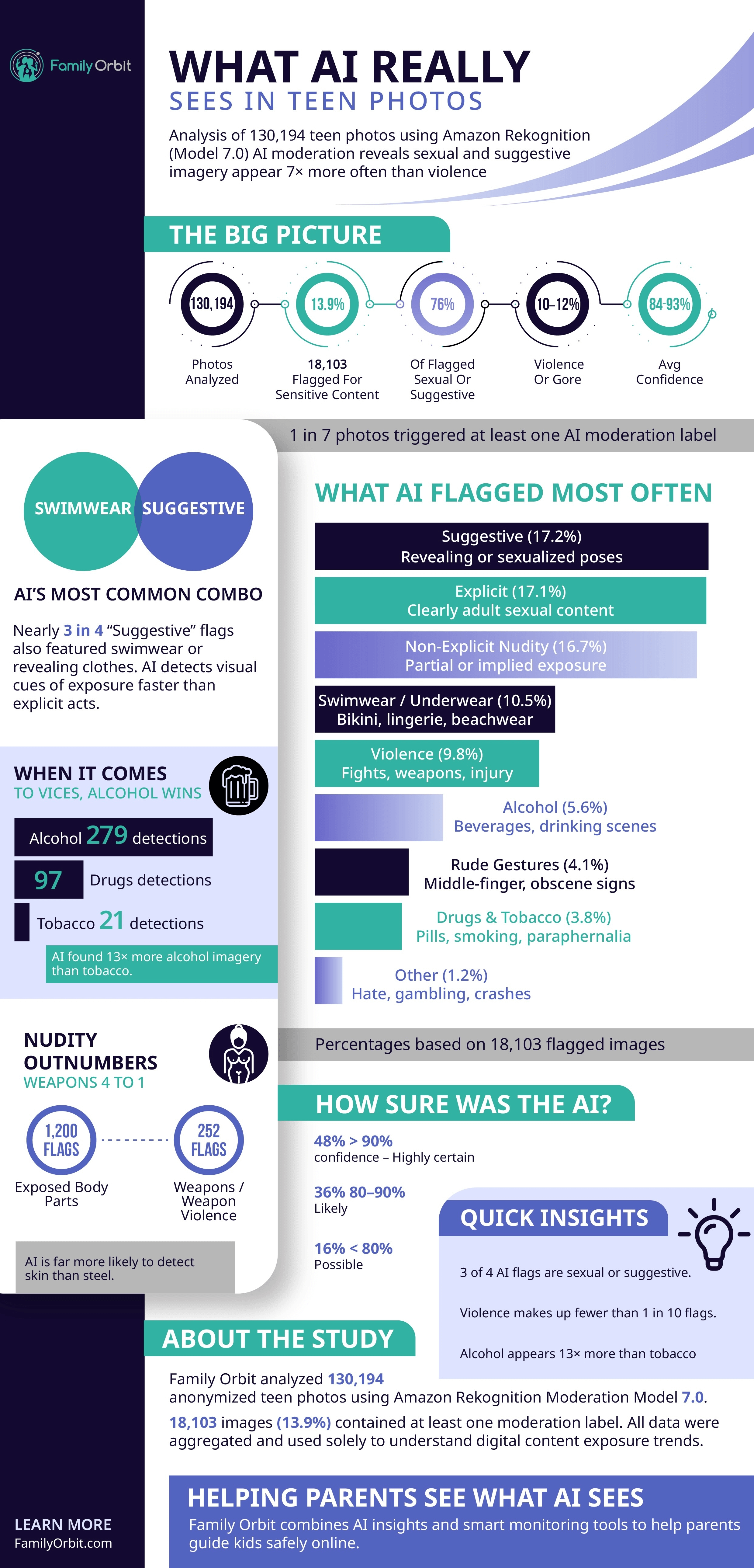
To find out, Family Orbit analyzed 130,194 teen photos using Amazon Rekognition Moderation Model 7.0. The results surprised us:
- 18,103 images were flagged for sensitive content
- 76% of those flags were sexual or suggestive
- Sexual cues appeared 7× more than violent cues
- Violence accounted for less than 10% of all flags
In other words?
AI sees bikinis far more often than it sees violence.
What the Study Found (Key Insights)
Across 130K+ images, Rekognition detected a clear moderation pattern:
- Suggestive and Explicit content dominate
Swimwear, underwear, revealing clothing, and partial nudity together made up the majority of all detections. - Violence and gore ranked far lower than expected
Categories like “Graphic Violence,” “Weapon Violence,” and “Blood & Gore” appeared in a small minority of cases. - Rude gestures, alcohol, and tobacco were present but minor
Gesture-related flags (mostly middle fingers) appeared more often than drugs or alcohol.
These patterns reveal how AI perceives teen digital behavior, not through a parental lens, but through an algorithmic one.
Why It Matters
AI moderation shapes:
- What social platforms remove
- What parental tools alert
- What appears in content feeds
- And how “safety” is defined for teens
But this study shows a bias toward sexual/suggestive cues over violent or harmful ones.
For parents, educators, and safety platforms, it introduces an uncomfortable truth:
AI systems are far more sensitive to swimsuits than to weapons.
Understanding this bias is crucial as platforms increasingly outsource safety decisions to machine-learning models.
Methodology
- Dataset: 130,194 anonymized teen photos provided by Family Orbit users.
- Model: AWS Rekognition Moderation Model 7.0
- Total flagged images: 18,103
- Top-level categories analyzed: Explicit, Suggestive, Violence, Alcohol, Tobacco, Rude Gestures, Drugs, and Non-Explicit Nudity
- Confidence filtering: Labels ≥ 60% confidence included
- Output: 90+ unique labels across 15 strong moderation parent classes
For transparency, we’ve included a small sample of the dataset used in this study:
Download the Full Infographic
👉 Download High-Resolution Infographic (PNG)
👉 Or embed it directly using the code below:
<img src="https://www.familyorbit.com/blog/infographic/bikinis-beat-violence-ai-study.png" width="100%" /><p>Source: <a href="https://www.familyorbit.com/blog/bikinis-beat-violence-ai-study/" target="_blank">Family Orbit</a></p>Conclusion
Sexual and suggestive content overwhelms every other category in AI moderation.
And while violence, drugs, and graphic content certainly exist online, they’re not what modern AI systems detect most often.
If we want safer digital spaces for teens, we need to understand what the algorithms prioritize and what they miss.
About Family Orbit
Family Orbit is a digital safety and parental monitoring platform used by families worldwide to protect their children online across iPhone and Android devices.
👉 Learn more about Family Orbit →
https://www.familyorbit.com/
- Monitor Calls & Text Messages
- View Photos and Videos
- Location Tracking & Geofence
- Monitor WhatsApp & Kik
- Detect & Alert for Inappropriate Activities
- Monitor Websites Visited
- Compatible with Android and iOS